|
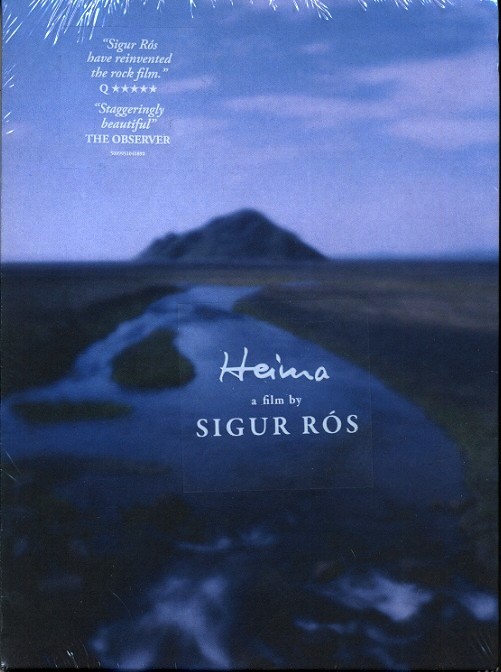
popplagið.com Sigur Rós Heima DVD EMI EU 2007 |
|||
|
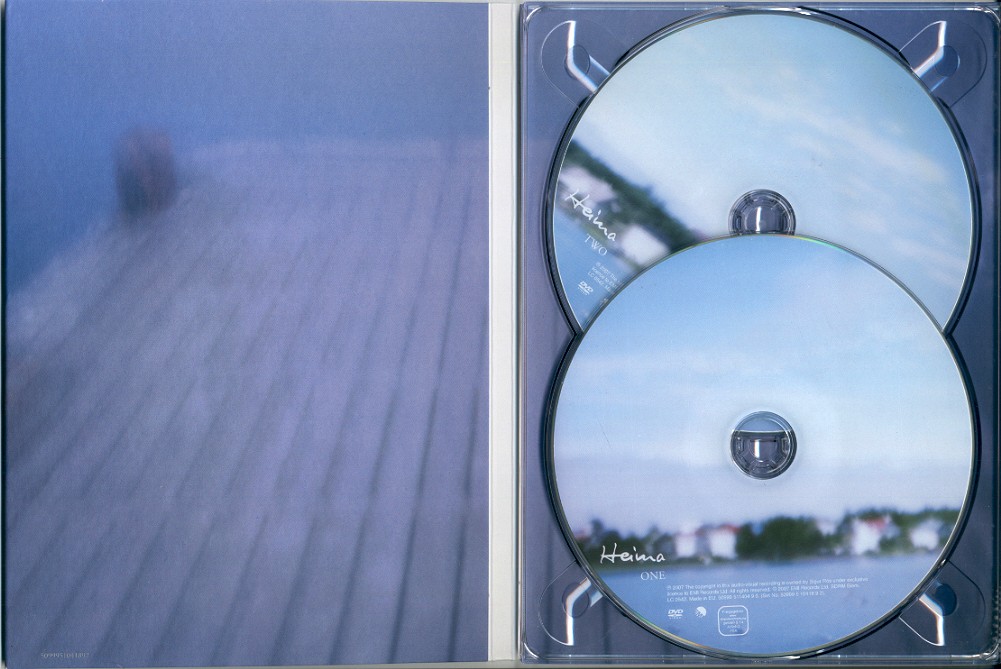
Standard edition - Double DVD plus special booklet of 8 pages EMI Records LTD |
|||
|
5099951041892 - 5104189 |
|||
| . | |||
|
|
|
||
| . | |||
|
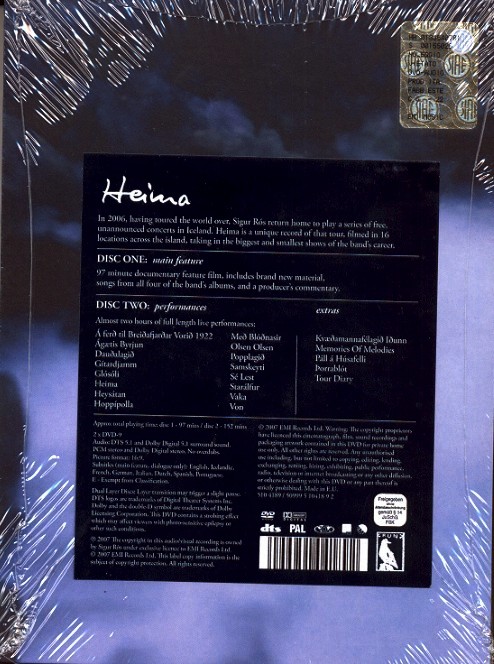
Disc 1. Contains the film itself as well
as an audio commentary by producer/manager John Best.
|
Disc 2: Contains full-length live performances of the songs featured in the film
1. Glósóli
|
||
|
|
|||
| . | |||
|
Bonus disc featuring over two hours of full length performances including
music from all four of the band's albums, alternate edits, a brand new song
recorded live in the band's own studio. |
|||
| . | |||
|
|
|||
| . | |||
| . | |||
 |
 |
 |
 |
|
page 1-8 |
page 2-3 |
page 4-5 |
page 6-7 |
|
click to resize |
|||
|
Heima 2 DVD edition includes 8 page book. |
|||
|
Directed by Dean DeBlois |
|||
|
Heima : Production Notes
|
|||
|
It’s strange to say now, but when we first thought about making a film of
Sigur Ros we didn’t immediately consider Iceland. The band hadn’t toured the
country this century, and the crowds in, say, Portugal were so very
excitable that our minds were initially elsewhere. At some point, however,
Kjartan mentioned that he’d had always had a notion that they should play a
show in the National Park at Asbyrgi in the far north of Iceland, and we
latched upon this as a sign. So, three years ago, in the middle of 2004, we made a reconnaissance trip to this strange canyon just shy of the Arctic Circle, to check Midsummer Day light levels and think about how we might stage such an event. In the end, we decided the midnight sun would be too bright for a film incorporating the band’s onstage lights and visuals, and the shoot was conceptually pushed back a few weeks to late July, to allow for some dark to creep into proceedings, but hopefully not so far as to make it too cold to play outdoors at night. We couldn’t shoot the following summer because the ‘Takk…’ album was about to come out and the band’s calendar was full of artwork deadlines and the like, and anyway they hadn’t played live for ages and would be too rusty to film. So instead we settled on the very end of the touring period, a whole year later, in the summer of 2006. Slowly the idea mushroomed. Seasoned Icelandic all-rounder, Kari Sturluson came in on the creative and logistical side, and gradually more locations were added - inevitably including a hometown show in Reykjavik - til we had a full tour of the island in our sights. Since certain shows had to be free for practical reasons, it was decided to make every stop on the tour free, and for Sigur Ros to roll into town with something like their full production, regardless of local facilities (or lack thereof) and the sheer expense and folly of the exercise. Only two of the shows, Reykjavik and Oxnadalur were publically announced, with the other smaller community hall show and Asbyrgi relying purely on word-of-mouth. In the event, the open-door policy worked amazingly well, with people of all ages, who would never have normally bought a ticket for a Sigur Ros show, just coming along to check it out. As the tour went round it gained a semi-mythical status, with the biggest national daily, Morgunbladid, saying in an editorial that this was some kind of gift that was joining the nation together at an important time. We stopped at many amazing places on the two-week jaunt around the country, some with audiences and some without. A disused herring factory at Djupavik, with its strange circular fish-oil tanks in which Jonsi sang ‘Gitardjamm’; a lonely protest camp against the building of a dam in the pristine wilderness; a traditional “Thorrablot” meal with an audience of pagans, among them. Although the band wanted a visual record of the live show with which they had just toured the world, we also wanted to deliver a different kind of experience of watching Sigur Ros than you get in a gig venue. Many people watch Sigur Ros with their eyes closed (sic) and enjoy the show as an overall experience. What we wanted was to move the camera in much closer and reveal what was actually going on on stage. We watched a lot of rock (and non-rock) films in trying to work out what we did and didn’t want to do in making what turned out to be ‘Heima’. We liked ‘Jazz On A Summer’s Day’, ‘Pink Floyd Live In Pompeii’ and ‘Walkabout’. We didn’t like ‘Travis Live At T In the Park’. Both ‘Pompeii’ and ‘Jazz…’ had amazing close-up photography that felt almost invasively intimate, the cutting was minimal and any camera motion – and there was little - was at snail’s pace. All these things were great. Plus ‘Jazz…’ also made amazing use of the audience at the 1958 Newport Festival. From Nic Roeg’s debut ’Walkabout’ we saw a way of making an ostensibly beautiful environment look annihilatingly huge, a place where humans really had little right to be, which is how Iceland had always seemed to us on our way round. In order to do this, we put aside any ideas of using American or European directors (we’d talked to a few), who might find the clichéd lures of volcanoes, geysers and the Blue Lagoon too irresistible, and went instead for an all-Icelandic crew, collected around local producer and man-who-can, Finni Johansson. We filmed eight shows, ranging from the smallest (Snaefell protest camp - incidentally the first time the band had ever played acoustically anywhere) to the biggest shows of the band’s career (Reykjavik was the largest show ever in Iceland with around 25,000 people), in addition to filming a bunch of locations without audiences. Denni Karlsson, the director of the summer filming, started the editing process in the early autumn, but the initial results fell somewhat short of the grand expectations we had had in trying to follow the footsteps of some of the most enduring music films ever made. We played around with the footage for months, trying to get a proper film out of it, before admitting that what we had was a bunch of pretty performances without much of a narrative thread to hold it together. Meanwhile, on a parallel track, we were talking to a guy called Dean DeBlois, a Canada-by-way-of-Hollywood dude, who’d written and directed ‘Lilo & Stitch’, and was asking us if we might want to get involved with a forthcoming animation feature. We’d met Dean the previous autumn at our Hollywood Bowl show and knew he was a keen fan of the band. So we didn’t feel too bad asking him for some advice with how to progress a movie that’s hitting the creative buffers. We knew he’d been Head of Story at Disney and figured he might be able to give us some pointers. We sent him the 120 hours of footage we’d shot in the summer and he spent a weekend staring at a computer screen. He also read the Tour Diary written at the time of the tour on the band’s fan-site, and for the first time worked out what exactly we’d been trying to accomplish all along. The next week he came back with what he thought we needed and said he’d be up for helping us get it. So, in the spring of 2007, Dean wound up in Iceland to shoot another substantial tranche of live footage with the intimacy brief to the fore, as well as environmental colour, sub-textural links and, crucially, the face-to-face interviews with the band, which – despite the fact that the band were uncomfortable with talking to camera - he felt would provide the glue to hold the whole thing together. He also came up with a title, ‘Heima’, which instantly seemed better than our, then sadly accurate, ‘Lost In The Lava’. Finally, we found English editor Nick Fenton, who was suggested by a mutual friend who had wanted use him for a Joy Division doc, but had graciously allowed us to “borrow” instead. Thankfully, Nick decided not to watch our blind alley edits and, looking at the work with fresh eyes, immediately found layers and connections that brought a new weight and power to the film. Between them, Nick and Dean provided the final missing pieces of this jigsaw project, producing a honed and impressive end result from what were pretty disparate elements. Dean’s undoubtedly commercial eye and Nick’s more experimental leanings seemed to hold each other in some kind of dynamic tension, lifting the film further and higher than we could have hoped or, at times, expected. ‘Heima’ was filmed on Hi Definition entirely on location in Iceland and mixed in Dolby 5.1. It was off-lined in London through June and July, and then finished in Los Angeles in August 2007. All the music was recorded live on the road with absolutely no overdubs by Birgir Jon Birgisson, who is the engineer at Sigur Ros’s studio in Alafoss, and Ken Thomas, co-producer of ‘Agaetis Byrjun’, ‘( )’ and ‘Takk…’. Heima : An introduction Last year, in the endless magic hour of the Icelandic summer, Sigur Rós played a series of concerts around their homeland. Combining both the biggest and smallest shows of their career, the entire tour was filmed, and now provides a unique insight into one of the world’s shyest and least understood bands captured live in their natural habitat. The culmination of more than a year spent promoting their hugely successful ‘Takk…’ album around the world, the Icelandic tour was free to all-comers and went largely unannounced. Playing in deserted fish factories, outsider art follies, far-flung community halls, sylvan fields, darkened caves and the hoofprint of Odin’s horse, Sleipnir*, the band reached an entirely new spectrum of the Icelandic population; young and old, ardent and merely quizzical, entirely by word-of-mouth. The question of the way Sigur Rós’s music relates to, and is influenced by, their environment has been reduced to a journalistic cliché about glacial majesty and fire and ice, but there is no doubt that the band are inextricably linked to the land in which they were forged. And the decision to film this first-ever Sigur Rós film in Iceland was, in the end, ineluctable. Shot using a largely Icelandic crew (to minimise Eurovision-style scenic-wonder overload), ‘Heima’ - which means both “at home” and “homeland” - is an attempt to make a film every bit as big, beautiful and unfettered as a Sigur Rós album. As such it was always going to be something of a grand folie, but one, which taking in no fewer than 15 locations around Iceland (including the country’s largest ever concert at the band’s Reykjavik homecoming), is never less than epic in its ambition. Material from all four of the band’s albums is featured, including many rare and notable moments. Among these are a heart-stopping rendition of the previously unreleased ‘Gitardjamm’, filmed inside a derelict herring oil tank in the far West Fjords; a windblown, one-mic recording of ‘Vaka’, shot at a dam protest camp subsequently drowned by rising water; and first time acoustic versions of such rare live beauties as ‘Staralfur’, ‘Agaetis Byrjun’ and ‘Von’. Heima is the first chance to see Sigur Rós live on DVD. November 5, 2007. * The huge horseshoe canyon at Ásbyrgi was, according to legend, formed by the hoofprint of this mythical beast. John Best, Manager Sigur Ros. 15th Sept 2007 - www.heima.co.uk
|
|||